
May 25, 2026
Radmila
Application Development & User Experience (UX)
Listen
Why Modern Applications Feel Faster (Even When They Aren’t)
Modern applications don’t necessarily run faster than older ones, but they are designed to feel faster. That distinction is subtle, yet it defines much of today’s user experience. When you open an app, scroll through a feed, or click a button, the response often appears instant. In reality, a lot is still happening behind the scenes. The difference lies in how that waiting time is managed, hidden, or reshaped into something that feels seamless.
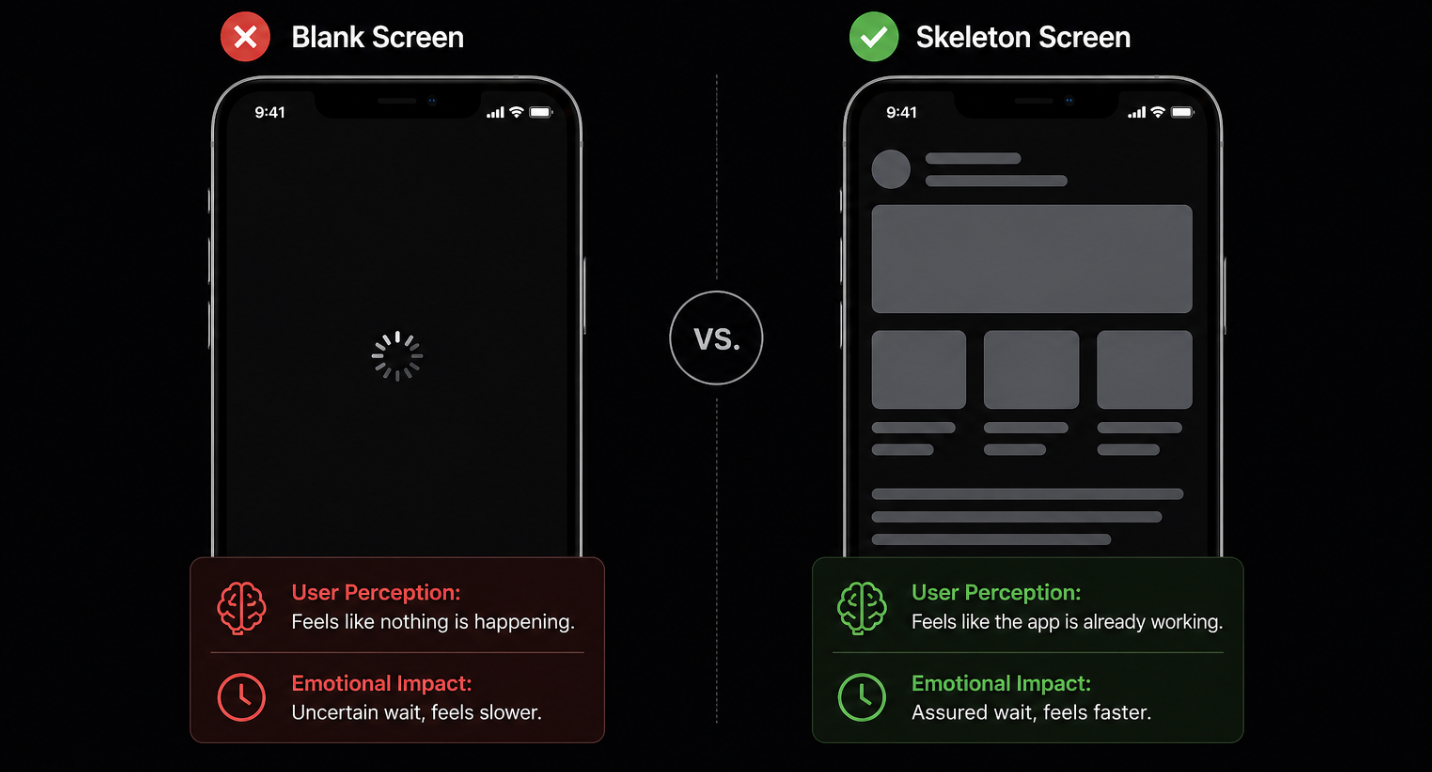
One of the key ideas behind this is perceived performance. Instead of focusing only on raw speed, developers design systems around how quickly a user feels something is happening. For example, when you open a modern app, you might see content placeholders, which are gray blocks that mimic the layout of real content. They don’t contain actual data yet, but they give your brain a sense that the app is already working. Compare that to a blank screen, the difference in experience is immediate.
Another major factor is progressive loading. Rather than waiting for everything to be ready, applications load the most important parts first. Images may appear gradually, text loads instantly, and additional elements fill in as you continue interacting. This creates a smooth flow where the user is never fully stuck waiting. Even if the total load time is the same, the experience appears faster because the user is never left waiting without feedback.
Modern apps also rely heavily on caching and prefetching. Caching stores data locally so it doesn’t need to be fetched again, while prefetching anticipates what you might do next and loads data in advance. For instance, when you hover over a link or scroll near the bottom of a page, the app may already be preparing the next set of content. When you actually click or continue scrolling, the content appears instantly, not because it loaded at that moment, but because it was already prepared.
Then there’s the role of micro interactions and animations. Small visual cues, like a button changing color when clicked or a subtle loading animation, signal that something is happening. These aren’t just aesthetic choices. They are functional. They reassure users that the system is responsive, even if the actual operation takes a bit longer. Without these cues, even a fast system can feel unresponsive.
Under the hood, modern architectures like APIs, CDNs, and distributed systems also contribute by delivering data more efficiently. But what truly sets today’s applications apart is not just their infrastructure. It’s the intentional design of the user experience. Developers prioritize what the user sees first, defer less critical tasks, and structure interactions to avoid moments of uncertainty.
In the end, modern applications are not defined by raw speed alone, but by how intelligently that speed is presented to the user. Through techniques like perceived performance, progressive loading, and thoughtful interaction design, developers reshape waiting into something almost invisible. What matters most is not how fast something actually happens, but how quickly it feels like it does. This shift from pure performance to perceived responsiveness is what makes today’s digital experiences feel smooth, reliable, and engaging, and it is ultimately what keeps users coming back.
Designing and developing digital experiences that move businesses forward.
Contact
hello@hoppsolutions.com
+49 155 1027 5723
+389 77 540 743
Office
Bul. Turisticka 21
6000 Ohrid, North Macedonia
Made with love by Hopp Solutions | 2026